
Define the model
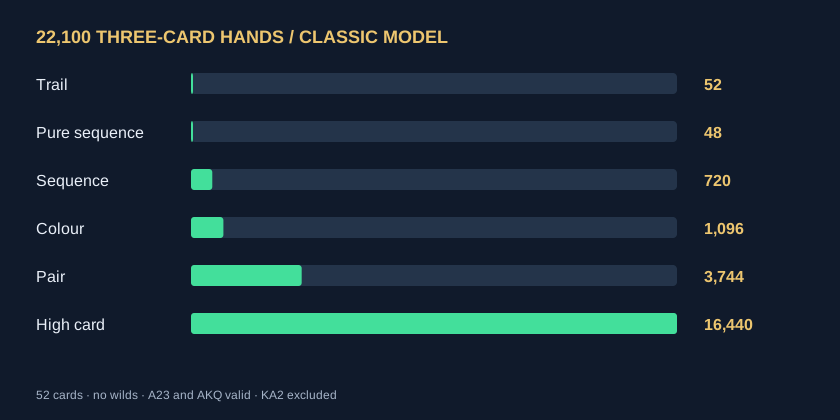
Choose three distinct cards without order from a 52-card deck, without jokers. Allow A–2–3 and A–K–Q as runs, and exclude K–A–2. There are C(52,3) = 52 × 51 × 50 ÷ 6 = 22,100 possible hands. Changing which ace run ranks higher leaves the category counts unchanged.
Exact distribution
| Category | Hands | Share |
|---|---|---|
| Trail | 52 | 0.2353% |
| Pure sequence | 48 | 0.2172% |
| Sequence | 720 | 3.2579% |
| Colour | 1,096 | 4.9593% |
| Pair | 3,744 | 16.9412% |
| High card | 16,440 | 74.3891% |
Derive the counts
- Trail: 13 ranks × C(4,3) = 52.
- Pure sequence: 12 valid rank runs × 4 suits = 48.
- Ordinary sequence: 12 × (4³ − 4) = 720; exclude the single-suit arrangements already counted above.
- Colour: 4 × C(13,3) − 48 = 1,096.
- Pair: 13 × C(4,2) × 12 × 4 = 3,744.
- High card: subtract the other five counts from 22,100 to obtain 16,440.
Rarity does not set the category order
Pure sequence has 48 combinations, slightly fewer than trail’s 52, but the classic category rule ranks trail higher. The ranking is a convention, not an automatic sorting of categories by rarity.
What the model cannot answer
It does not include opponents’ exposed information, wild cards, table actions or app-specific dealing code. It is not a fairness audit or the probability that your hand beats a particular opponent. A series of weak hands after independent reshuffles does not make a strong hand due.
How this edition is checked
The classifier is enumerated across every three-card combination and checked against the counts above under both ace-order settings. The comparer is also checked for reversed results, equal-strength hands and duplicate-card rejection. The static test report is included in the delivery documentation; no app APK was involved.