
Prepare the lesson
Use a standard 52-card deck without jokers, or the browser hand lab. Select three distinct cards for each imaginary player. State the ace-sequence convention before comparing ace runs; the rest of this exercise uses the six classic categories.
Traditional wagering rounds have additional action rules. Those are not necessary for learning how to classify and compare the cards, and a mobile app may implement its own table conditions.
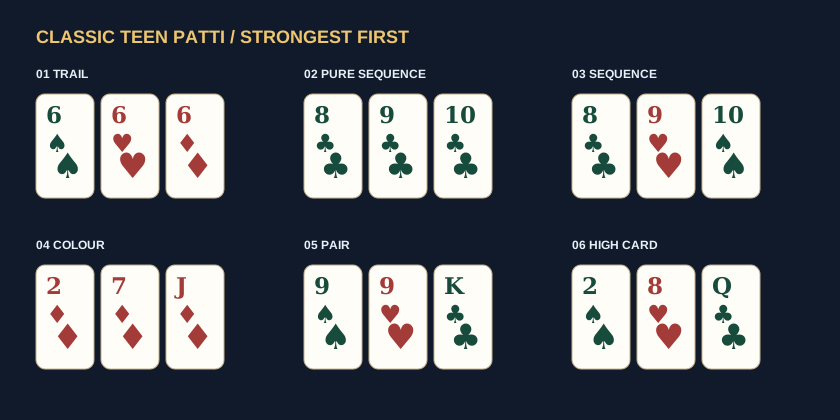
Recognise the categories
| Order | Category | Definition | Example |
|---|---|---|---|
| 1 | Trail / trio | Three equal ranks | 6♠ 6♥ 6♦ |
| 2 | Pure sequence | Consecutive ranks, one suit | 8♣ 9♣ 10♣ |
| 3 | Sequence / run | Consecutive ranks, mixed suits | 8♣ 9♥ 10♠ |
| 4 | Colour / flush | One suit, not consecutive | 2♦ 7♦ J♦ |
| 5 | Pair | Two equal ranks | 9♠ 9♥ K♣ |
| 6 | High card | None of the above | 2♠ 8♥ Q♣ |
Walk through a complete comparison
- Give A the hand 7♠ 7♥ A♦ and B the hand 8♣ 8♦ 2♠.
- Classify both as pairs. Since the categories match, compare the paired ranks.
- Eight is higher than seven, so B wins this comparison. The spare ace in A does not override the pair rank.
- Replace B’s hand with 2♣ 7♣ J♣. B now has a colour, which still beats A because category order comes first.
Understand the action vocabulary
| Word | Basic meaning |
|---|---|
| Blind | The player has not looked at the cards. |
| Seen | The player has looked. This changes available information, not the cards. |
| Pack / fold | Leave the current hand. |
| Show | Compare remaining hands under the table’s conditions. |
| Side show | A conditional comparison request in some rule sets. |
| Boot | A starting contribution in conventional wagering play; not needed in this lesson. |
Confirm rules before joining any table
Ask about ace order, wild cards, action limits, ties and when comparisons are allowed. Do not treat a short generic guide as the complete rules of an untested app. The variation guide explains why a different mode can change the evaluation.
A ten-minute practice target
Classify six fixed hands, then explain three comparisons aloud. If you can state whether category, paired rank, sequence order or a spare card decided the result, you have a useful foundation. Use the hand lab to change one card and see what changes.
A one-card change exercise
WORKED EXAMPLE
A one-card change exercise
Start with 8♠ 9♠ 10♠. Change only the ten to hearts and name the new category. Then change that ten to Q♥. Keeping two cards fixed makes it easier to see whether suit or consecutiveness caused the change.
Beginner questions
Do all red cards make a colour?
No. Hearts and diamonds are different suits. A colour requires one suit.
Is A–K–Q always the highest sequence?
No. Check the stated convention for A–2–3 versus A–K–Q.
Do the rules here verify an app?
No. The lesson explains the card model; it is not an APK test or a claim about a named app’s exact implementation.
Sources and observation limits
Source observation edition: 22 October 2026. A listing observation is separate from an APK measurement. Review the exact file record for any offered release; availability and descriptions may change.